Modern professionals are facing a productivity challenge.
Not because they lack tools.
Not because they lack skills.
But because the amount of information, communication, meetings, and operational decisions they handle every day has increased significantly.
A CEO may spend hours reviewing emails, preparing meetings, analysing reports, and coordinating teams.
A manager may spend a large part of the day tracking tasks, following up with team members, updating documents, and preparing status reports.
A professional may constantly switch between applications, messages, calendars, and different productivity tools.
The challenge is no longer only about completing tasks.
The challenge is managing complexity.
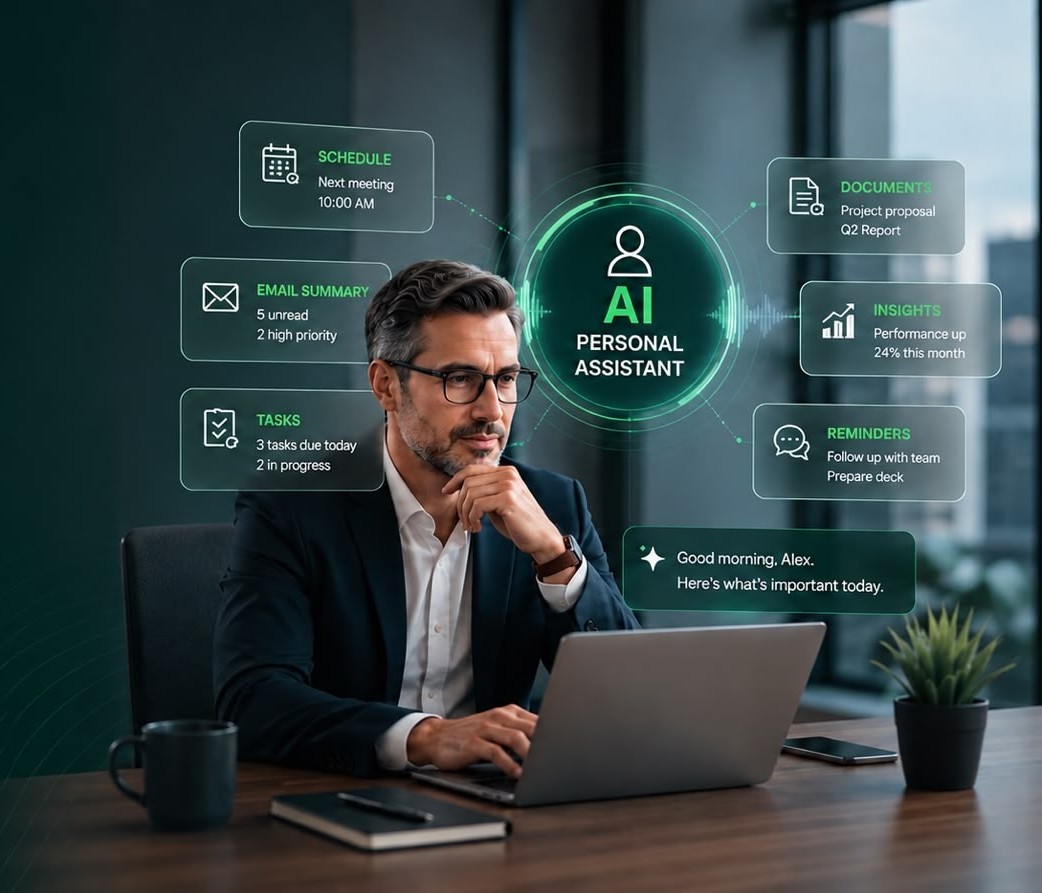
This is where AI personal assistants are changing the way professionals work.
An AI personal assistant is not simply a chatbot that answers questions.
It is an intelligent digital system designed to understand workflows, organise information, automate repetitive activities, provide insights, and support better decision-making.
From scheduling meetings and summarising documents to analysing business information and managing daily priorities, AI assistants are becoming valuable productivity partners for modern professionals.
The Evolution of Personal Assistants: From Manual Management to Intelligent Support
Traditional personal assistants have always played an important role in helping executives and professionals manage their schedules and responsibilities.
BuHowever, traditional assistance depends heavily on human availability and manual coordination.
A modern AI personal assistant works differently.
It can process large amounts of information, understand patterns, automate repetitive activities, and provide instant support whenever required.
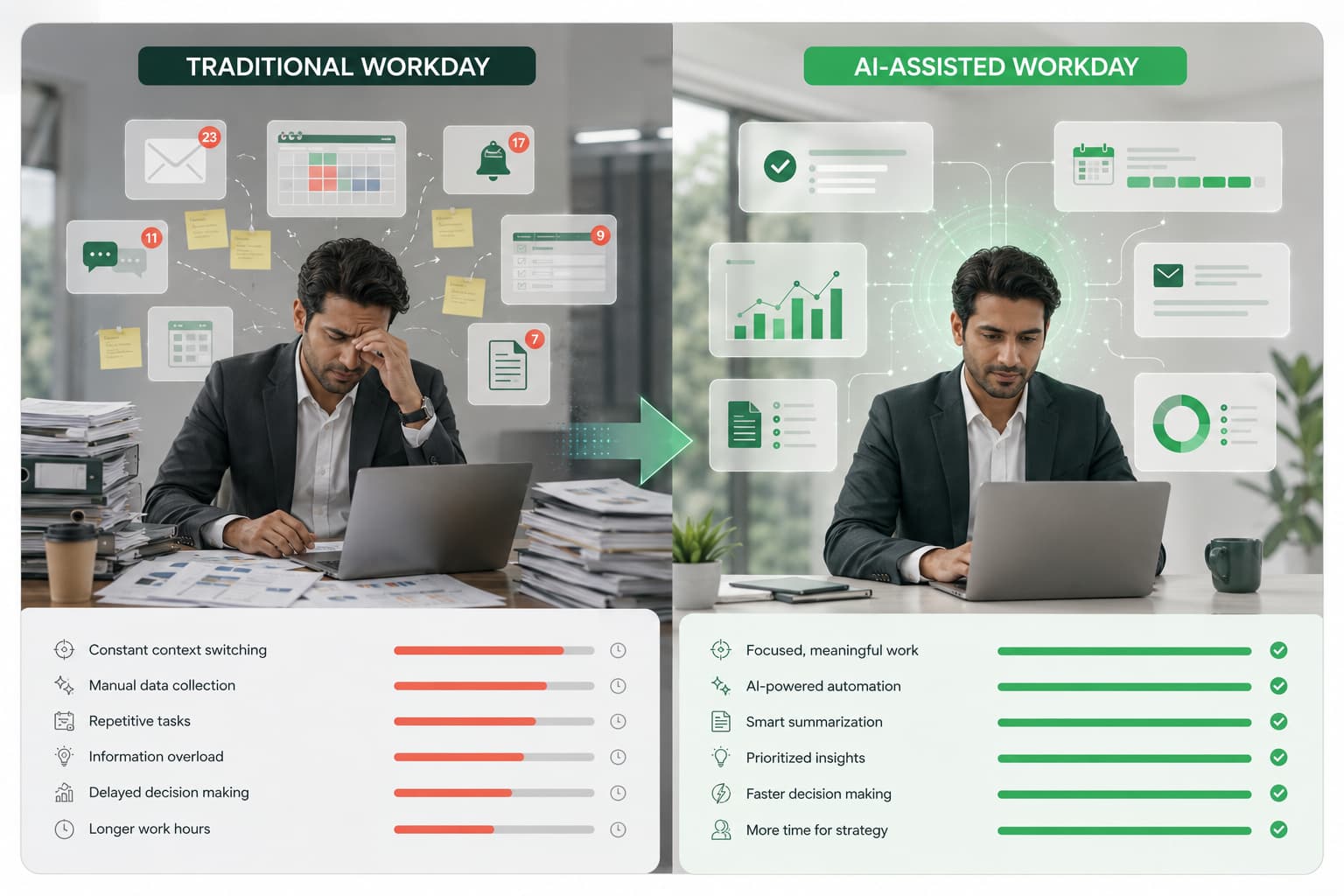
The transformation can be understood through three stages:
Traditional Work Management vs AI-Assisted Work Management
 How AI Personal Assistants Are Changing Professional Work
The biggest advantage of AI personal assistants is not replacing human intelligence.
It is increasing human capability.
Professionals spend a significant amount of time on repetitive activities that require attention but not necessarily strategic thinking.
Examples include:
- Organising meetings
- Managing calendars
- Writing repetitive emails Creating summaries
- Searching information
- Preparing reports
- Tracking follow-ups
- Managing task priorities
AI assistants can handle these activities and allow professionals to focus on higher-value responsibilities such as decision-making, innovation, leadership, and customer relationships.
For executives and business leaders, this shift is especially valuable because time is one of the most limited resources.
A few hours saved every week through intelligent automation can create a significant productivity impact over months and years.
Through solutions such as AI integration service, businesses can connect AI capabilities with their existing tools, workflows, and operational systems to create personalised productivity solutions.
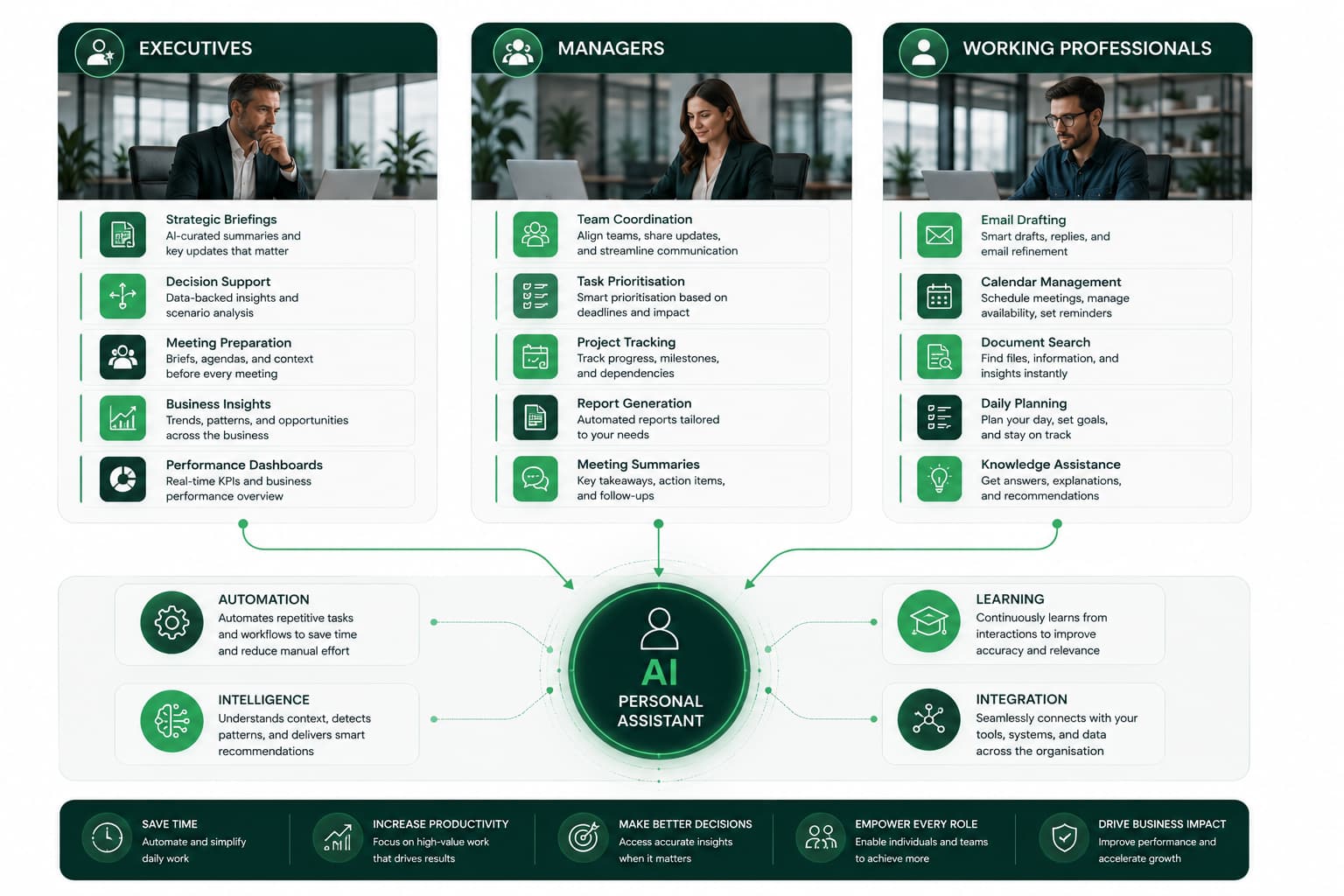
AI Personal Assistants for C-Suite Executives and Business LeadersExecutives and decision-makers manage a unique combination of responsibilities.
Their day often includes:
- Strategic discussions
- Leadership meetings
- Financial decisions
- Customer conversations
- Market analysis
- Team coordination
- Business planning
The challenge is that important decisions often require collecting information from multiple sources.
An AI personal assistant can help executives by acting as an intelligent information layer.
It can:
- Summarise important communications
- Prepare meeting briefs
- Highlight important business updates
- Organise priorities
- Analyse documents
- Provide quick access to relevant information
Instead of spending time searching for information, leaders can spend more time understanding insights and making decisions.
 AI Personal Assistants for Managers: Reducing Operational Complexity
Managers are often responsible for balancing multiple priorities simultaneously.
They coordinate teams, monitor project progress, assign responsibilities, conduct meetings, review reports, and ensure deadlines are met. While these activities are essential, many of them involve repetitive administrative work that consumes valuable time.
An AI personal assistant can significantly reduce this operational burden by acting as an intelligent workplace companion rather than simply another software application.
Instead of manually tracking dozens of conversations, documents, and tasks, managers can rely on AI to organise information, identify priorities, and automate routine activities.
For example, an AI assistant can:
- Summarise lengthy meeting discussions.
- Generate action items automatically.
- Send follow-up reminders to team members.
- Track project progress across departments.
- Organise daily priorities.
- Prepare weekly performance summaries.
- Search company knowledge instantly.
This allows managers to spend less time coordinating work and more time coaching teams, solving business problems, and driving performance.
Businesses implementing AI automation solutions can extend these capabilities across multiple departments, creating consistent workflows that improve operational efficiency without increasing manual effort.
AI Personal Assistants for Working ProfessionalsThe benefits of AI personal assistants are not limited to senior leadership.
Professionals across marketing, finance, sales, human resources, operations, customer support, and technology can all improve their productivity by automating repetitive daily activities.
A typical workday involves switching between numerous applications, responding to emails, attending meetings, preparing documents, updating spreadsheets, and searching for information.
While each activity appears small individually, together they consume a significant portion of the working day.
An AI personal assistant helps professionals reduce this constant context switching by becoming a central productivity layer.
Instead of opening multiple applications to complete different tasks, professionals can interact with a single intelligent assistant that coordinates information across various systems.
Examples include:
- Drafting professional emails.
- Creating meeting summaries.
- Organising daily schedules.
- Generating presentation outlines.
- Retrieving company documents.
- Preparing project updates.
- Answering internal knowledge questions.
The result is not fewer responsibilities.
The result is completing those responsibilities with greater speed, accuracy, and consistency.
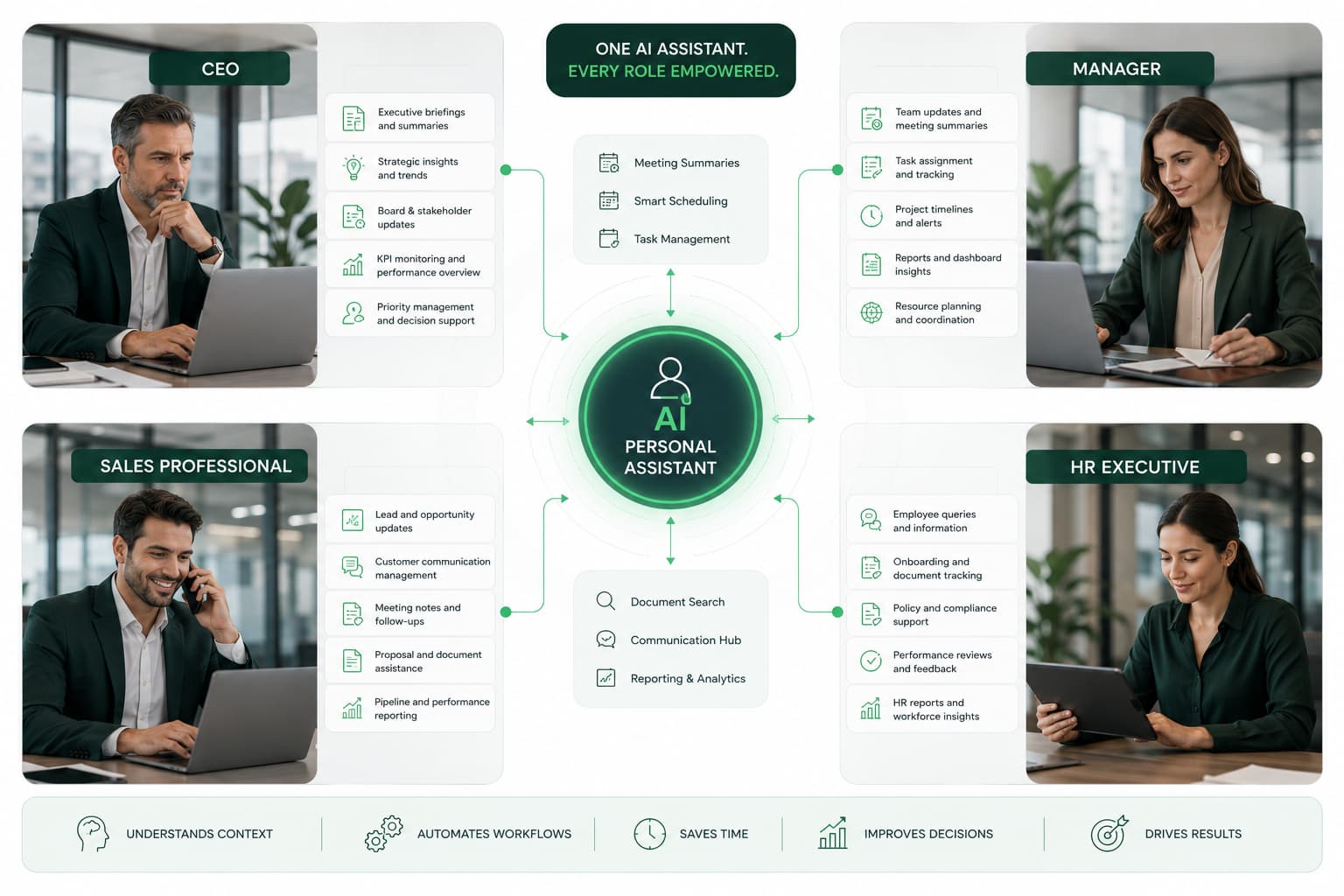
How an AI Personal Assistant Fits Into Your Daily Workflow
One of the biggest misconceptions about AI is that it replaces existing business software.
In reality, a modern AI personal assistant works alongside the tools professionals already use every day.
Rather than forcing businesses to adopt an entirely new system, AI acts as an intelligent layer that connects calendars, communication platforms, project management software, CRM systems, cloud storage, documents, and internal knowledge bases.
Instead of searching across multiple applications, users can simply ask their AI assistant to retrieve information, perform an action, or generate insights.
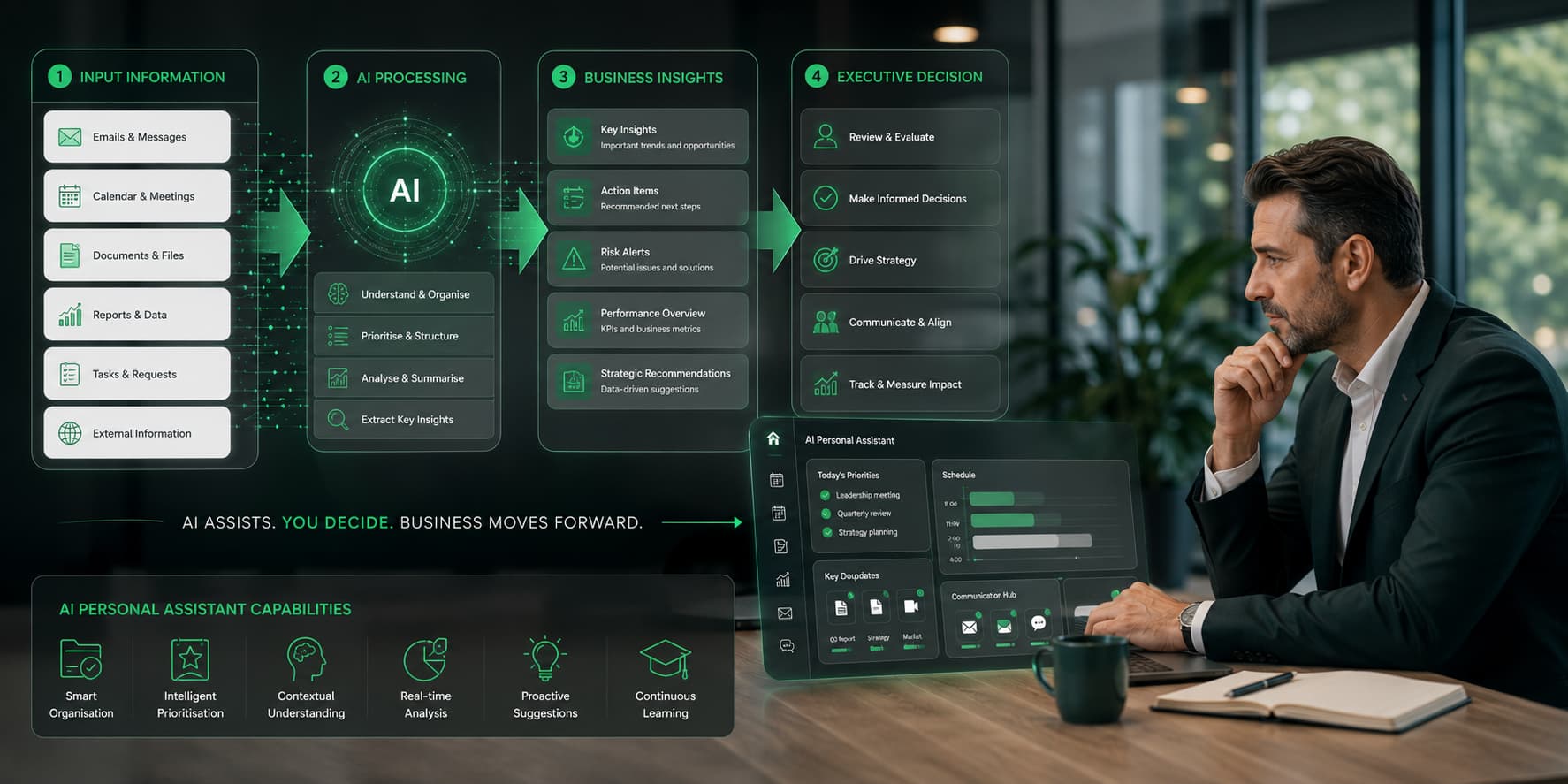
A typical workflow may look like this:
- Meetings from the calendar are automatically organised and prioritised.
- Emails are analysed and categorised based on urgency.
- Documents are summarised before important meetings.
- Action items are extracted automatically.
- Follow-up reminders are scheduled.
- Daily reports are generated.
- Business insights are presented before the workday begins.
The objective is not to replace people.
The objective is to eliminate repetitive administrative work so professionals can focus on higher-value responsibilities.
Organisations adopting AI integration services often integrate AI assistants with their existing business applications to create a unified digital workspace rather than isolated automation tools.
Visualising the AI Personal Assistant Workflow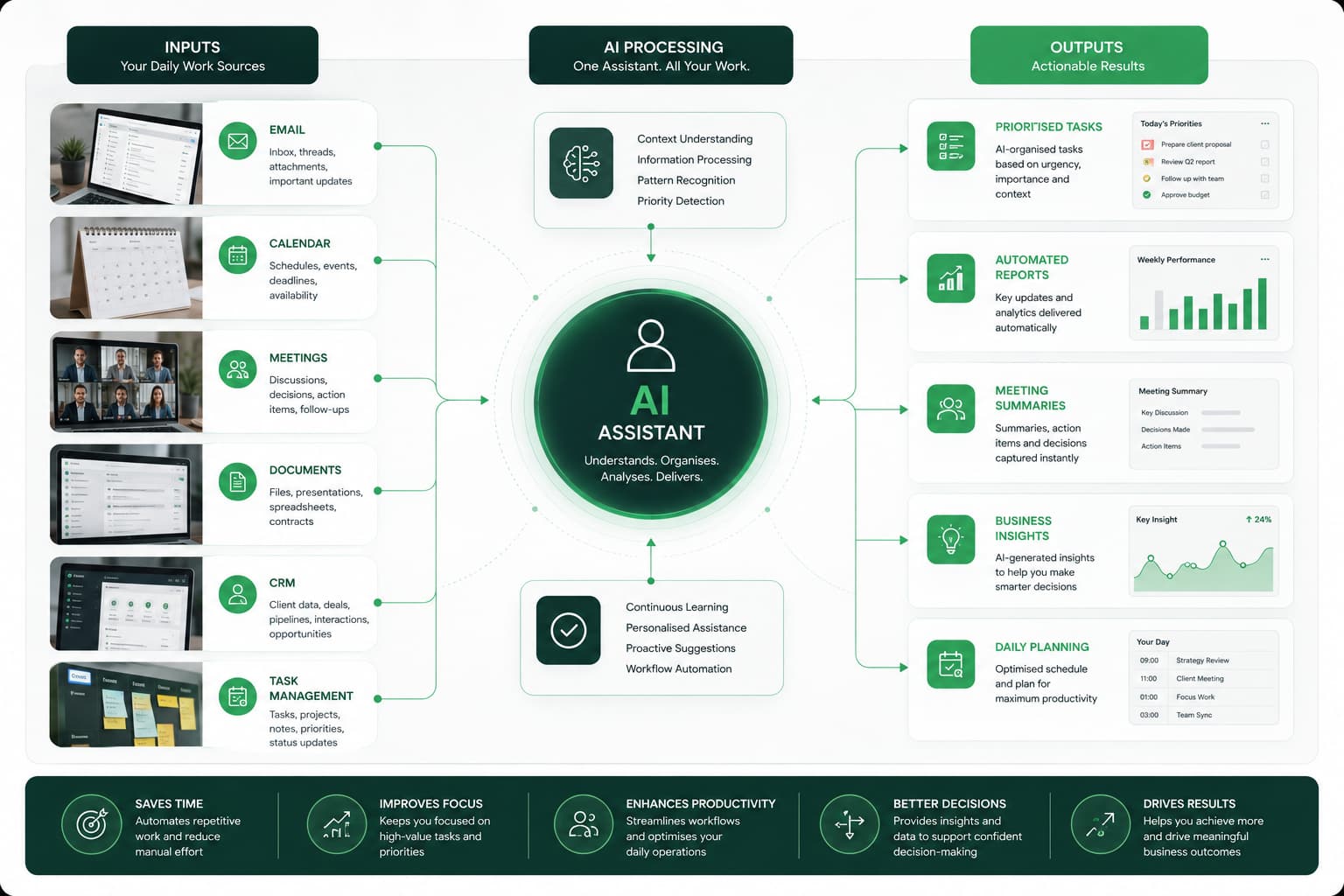
Beyond Productivity: AI as a Decision Support System
The next evolution of AI personal assistants goes beyond automation.
Modern AI systems are increasingly helping professionals make better decisions by analysing information, identifying patterns, and presenting relevant insights at the right time.
For example, instead of reading multiple reports before a board meeting, an executive could ask the AI assistant:
Summarise our sales performance for the last quarter, identify the top-performing regions, highlight declining product categories, and prepare discussion points for today's leadership meeting.
Within seconds, the assistant can consolidate information from multiple sources into a concise, actionable briefing.
Similarly, managers can request updates on project risks, customer issues, or operational bottlenecks without manually reviewing multiple dashboards.
This transforms AI from a productivity tool into an intelligent decision-support system.
Businesses investing in custom software development can build AI assistants tailored to their unique workflows, ensuring that recommendations and insights are based on company-specific data rather than generic information.
References
- Microsoft - 2025 Work Trend Index
https://www.microsoft.com/worklab/work-trend-index - McKinsey & Company – The State of AI
https://www.mckinsey.com/capabilities/quantumblack/our-insights/the-state-of-ai
Voice AI Personal Assistants: The Next Step in Workplace Productivity
Typing is no longer the only way professionals interact with technology.
Voice-enabled AI personal assistants are becoming increasingly valuable because they allow users to complete tasks while travelling, attending meetings, or working away from their desks.
Instead of manually searching through applications, professionals can simply ask their AI assistant to perform specific actions.
Examples include:
- Schedule a meeting with the sales team next Tuesday.
- Summarise yesterday's client meeting.
- Show today's highest-priority tasks.
- Prepare a follow-up email for the proposal discussion.
- Find the latest quarterly sales report.
The AI assistant processes the request, retrieves the required information, and performs the task within seconds.
For executives and managers who spend much of their day in meetings, this creates a far more natural and efficient way of interacting with business information.
Businesses implementing Voice Agent services can create secure AI assistants that understand organisation-specific workflows, enabling employees to access information and complete actions through natural conversations rather than manual navigation.
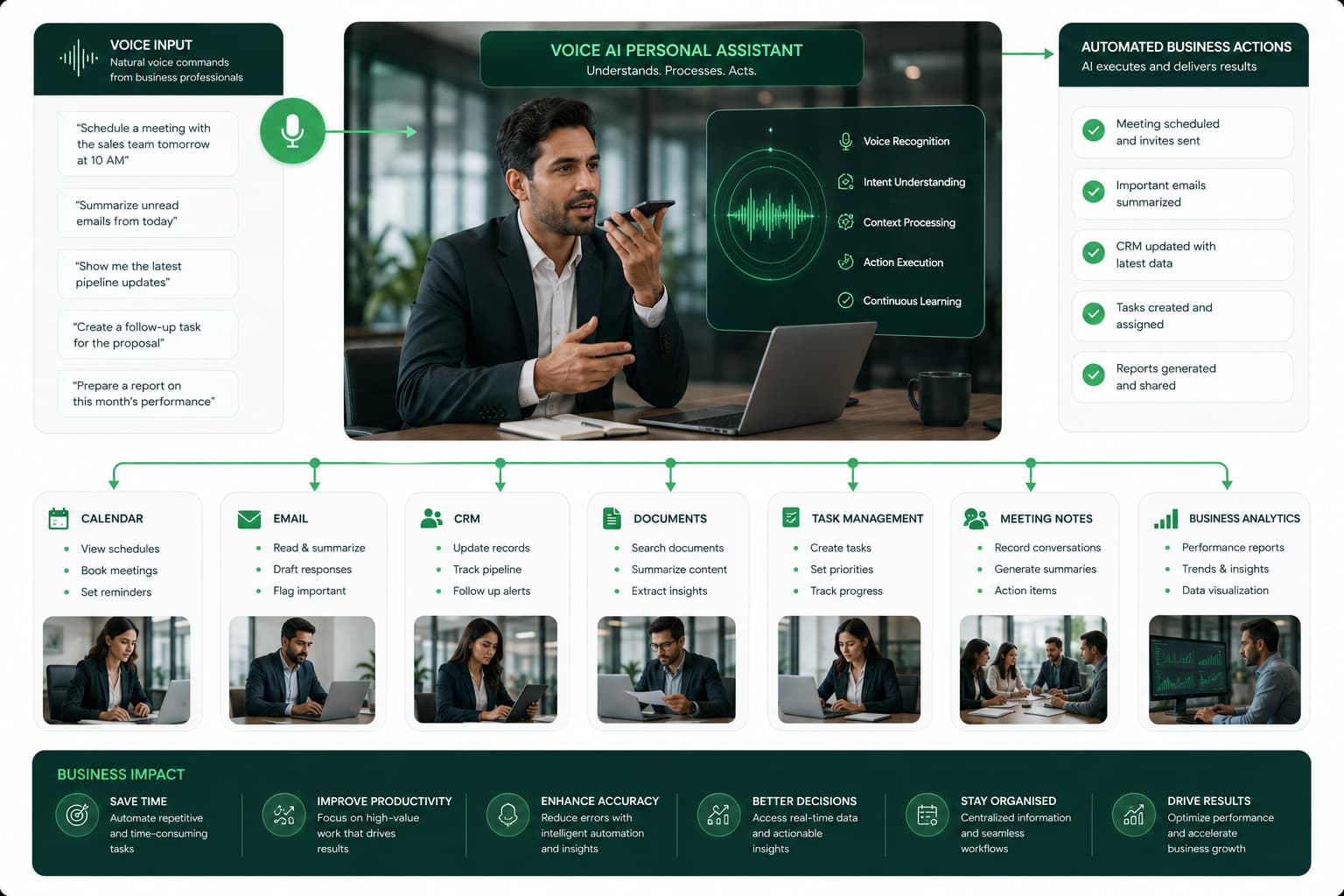
AI Personal Assistants Are Most Powerful When Connected to Business Systems
Many organisations believe implementing an AI assistant simply means giving employees access to a conversational AI tool.
In reality, the greatest value comes when the assistant is integrated with the systems employees already use every day.
An AI personal assistant becomes significantly more capable when it can securely access business applications such as:
- CRM platforms
- ERP systems
- Project management software
- HR management systems
- Accounting platforms
- Knowledge bases
- Email and communication tools
- Cloud document repositories
Instead of employees searching across multiple applications, the AI assistant becomes a central intelligence layer that retrieves information, automates actions, and presents insights from a single interface.
For example, a sales manager could ask:
'Which enterprise opportunities have not received a follow-up in the last seven days?'
Instead of manually checking the CRM, filtering records, and preparing a report, the AI assistant retrieves the information instantly and presents it in an actionable format.
This type of intelligent integration is becoming increasingly important as organisations adopt more digital tools.
Businesses investing in AI integration services can create connected AI ecosystems where information flows seamlessly across departments, improving collaboration and reducing manual effort.
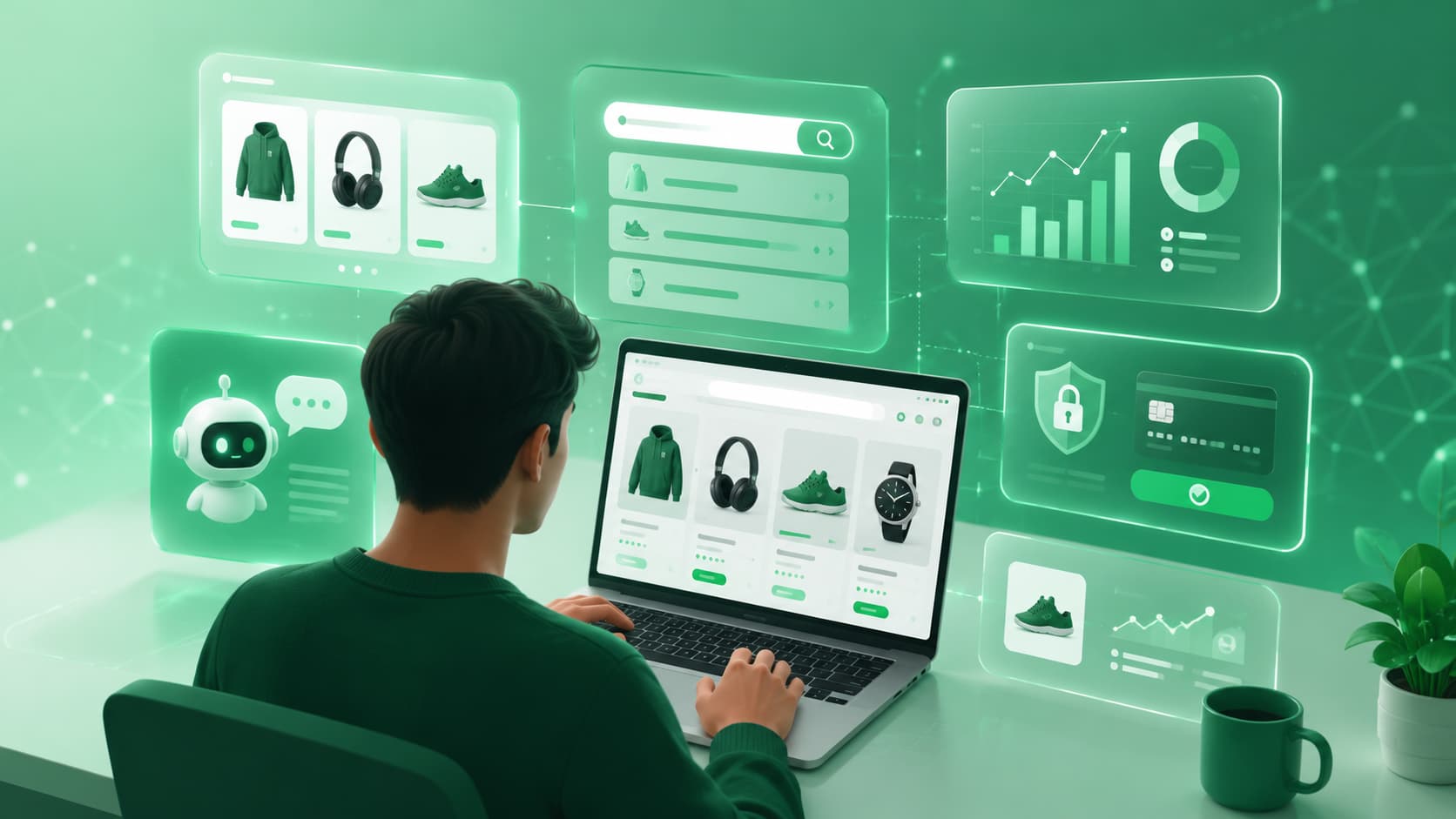
AI Personal Assistant Ecosystem
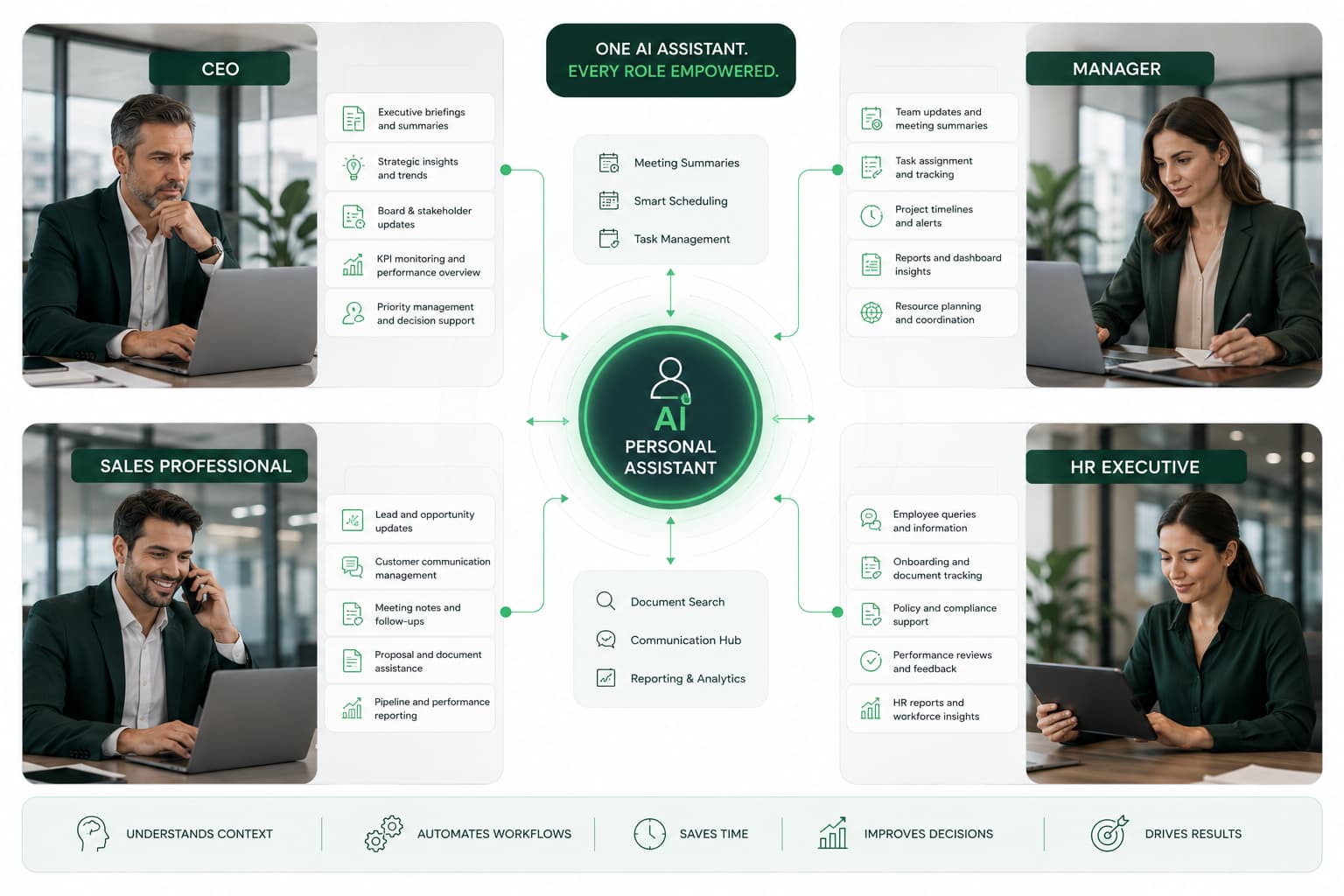
Key Benefits of AI Personal Assistants for Modern Organisations
The value of an AI personal assistant extends beyond individual productivity. When adopted across an organisation, it creates measurable improvements in operational efficiency, communication, and decision-making.
Some of the most significant benefits include:
- Reduced administrative workload through intelligent automation.
- Faster access to business information.
- Improved meeting preparation and follow-ups.
- Better task prioritisation and time management.
- Consistent documentation and reporting.
- Enhanced collaboration across teams.
- Quicker decision-making through AI-generated insights.
- Increased employee productivity without increasing headcount.
These improvements allow organisations to focus more on strategic initiatives while reducing the time spent on repetitive operational activities.
Human Intelligence + Artificial Intelligence = Better Business Outcomes
One of the biggest misconceptions surrounding AI is that it is designed to replace professionals.
In reality, the most successful AI implementations are those that augment human capabilities rather than replace them.
An AI personal assistant does not make strategic business decisions.
It organises information, automates repetitive work, surfaces relevant insights, and ensures that professionals have the right information at the right time.
The executive still leads.
The manager still manages.
The employee still creates value.
AI simply removes unnecessary friction from daily work.
This collaborative approach allows organisations to achieve higher productivity while preserving the creativity, judgement, and experience that only people can provide.
ReferencesReferences
- Microsoft WorkLab – 2025 Work Trend Index
https://www.microsoft.com/worklab/work-trend-index - McKinsey & Company – The State of AI
https://www.mckinsey.com/capabilities/quantumblack/our-insights/the-state-of-ai - IBM – What Is an AI Assistant?
https://www.ibm.com/think/topics/ai-assistant - Google Cloud – Generative AI for Enterprise
https://cloud.google.com/ai
Final Thoughts
References
- Microsoft WorkLab – 2025 Work Trend Index
https://www.microsoft.com/worklab/work-trend-index - McKinsey & Company – The State of AI
https://www.mckinsey.com/capabilities/quantumblack/our-insights/the-state-of-ai - IBM – What Is an AI Assistant?
https://www.ibm.com/think/topics/ai-assistant - Google Cloud – Generative AI for Enterprise
https://cloud.google.com/ai
Final Thoughts
Artificial intelligence is no longer a technology reserved for large enterprises or specialised technical teams.
Today, AI personal assistants are becoming practical workplace companions that help executives, managers, and professionals manage their responsibilities more efficiently. From organising meetings and summarising documents to automating repetitive tasks and supporting faster decision-making, these systems are redefining how modern organisations operate.
The organisations gaining the greatest advantage are not those replacing people with AI.
They are the ones enabling their people to work more effectively with AI.
As business environments become increasingly fast-paced and information-driven, professionals need tools that reduce complexity rather than add to it. An AI personal assistant serves exactly that purpose by acting as a central intelligence layer that connects information, automates workflows, and delivers meaningful insights when they are needed most.
Whether you are leading an organisation, managing a department, or contributing as an individual professional, adopting AI is no longer simply about improving productivity.
It is about creating a smarter way of working.
Businesses looking to move beyond generic AI tools can explore AI automation solutions, AI integration services, or Voice Agent Development to build AI assistants tailored to their unique operational requirements and long-term business goals.
AI Personal Assistant Capability Matrix